Tuesday, March 29, 2011

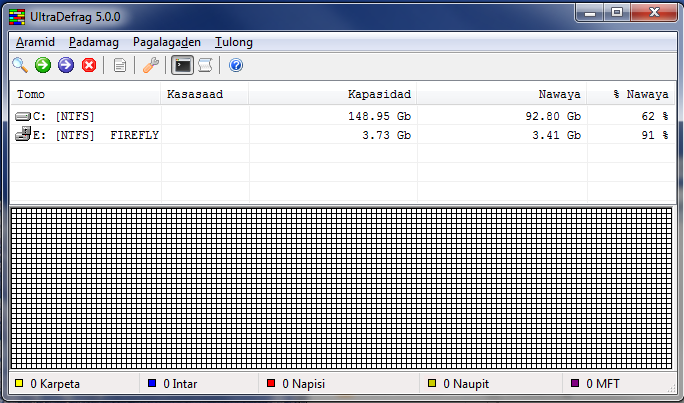
Ultradefrag v5.0 will have an Iloko UI... and a Tagalog one, too.

I came across Ultradefrag not too long ago as a replacement for the built-in defragmenter in Windows or Diskeeper. It's pretty much a stand-alone application with few bells and whistles.

Main page: http://ultradefrag.sourceforge.net/

Like any open-source project, contributions to localizing the application are welcome. I signed up on the project's wiki. Now, Iloko is one of two Filipino languages that will be part of version 5.0, now in Beta 2. The other is Tagalog (Filipino). I've edited that version also because some many of the strings were flat-out incorrect, I'll assign hot keys after I'm done with the Iloko version.

Localization Wiki: http://ultradefrag.wikispaces.com/Translations+v5.0.0

I was able to make edits without creating an account. If anyone would like to contribute time testing or translations, you welcome.


Wednesday, March 23, 2011

Addressing the User in Software

This is the first of responses to the fil-fil-StyleGuide.doc that is available for download from the Microsoft Language Portal. Select Filipino from the drop-down list, and then click Download. It is a Microsoft Word document packaged in a Zip file.

A consideration when localizing software is how the text addresses the user. In English, there is only one second-person pronoun for both singular and plural alike: "you". The software addresses at most one user, so the decision to use a singular or plural form is moot: use singular when localizing. English also lacks the T-V Distinction, or the distinction between a formal and informal form of the second-person pronoun and related verb forms. Which one is used depends on the relationship between the speaker and the listener. But, many languages such as Spanish, German and French have the distinction and software localized for those languages, the formal form is used when addressing the user in software. A language such as Japanese, lacks true personal pronouns, yet the translations use polite verb forms instead of the "dictionary" forms as it is considered impolite in such a context.

Examples:
Language Formal Informal
English Do you want to delete the file? Do you want to delete the file?
Spanish ¿Desea Usted eliminar el archivo? ¿Deseas (tú) eliminar el archivo?
Catalan Voleu suprimir el fitxer? Vols suprimir el fitxer?
French Voulez-vous supprimer le fichier? Voules-tu supprimer le fichier?
German Möchten Sie die Datei löschen? Möchtest du die Datei löschen?
Japanese ファイルを削除しますか。 ファイルを削除?

In each of the example languages, the use of the second-person singular pronouns and verb forms in the formal phrases is avoided. Spanish uses the pronoun Usted with third-person singular forms of the verb. Catalan and French use the second-person plural pronoun with corresponding second-person plural verb forms. German uses the pronoun Sie with third-person plural verb forms. Tagalog follows the same pattern as Catalan and French. The polite way of addressing seniors, persons of authority and strangers is to use the second-person plural forms, kayo-ninyo-inyo. For peers, children and those of lower social status than the speaker the forms are ka/ikaw-mo-iyo.*

Suggestion according to the "Style Guide"

Contradictory to the normal T-V distinction in Tagalog, however, the Filipino Style Guide suggests the use of the second-person singular forms! But, with a slight modification. According to section 3.1.2 of the guide,
"Another rephrasing recommendation is the use of the pronoun ‘iyo’ instead of ‘mo’... The use of 'mo' feels more informal and familiar."
What's more is that the example that is given at the end of the section betrays the recommendation solely based on grammaticality:
"If  you are using xyz.yyy.edu  as your secondary proxy address, add xyz.yyy.edu as an accepted domain.
Kung iyong ginagamit ang xyz.yyy.edu bilang pangalawang proxy address , kailangan mong idagdag ang xyz.yyy.edu bilang xyz.yyy.edu bilang katanggap-tanggap na domain."**
The personal pronoun after the verbal "kailangan" in the example must be "mo" because this form is strictly required. The clause can be rephrased as "...ang iyong kailangan ay..." with "kailangan" treated as a noun, but it is rather stilted and awkward. The suggestion to use "iyo" as a possessive instead of "mo" is still valid. Pre-positioned possessives may occur before their nouns as an alternate to following them as is the norm in most cases. And, the reason for using "iyo" is...
"To achieve the businesslike tone, sometimes a target text has to be paraphrased or restructured to avoid ‘sounding too familiar’. "

Nevertheless, "iyo" is still a second-personal singular pronoun and still "familiar". In fact, it is the oblique form and is commonly used in prepositional phrases following "sa".

Examples:
  • dahil sa iyo "because of you"
  • para sa iyo "for you"
  • tungkol sa iyo "about you"
Recommending the use of "iyo", does not avoid situations when "mo" is required by Tagalog syntax. In addition, the use of "mo" or "ka/ikaw" is unavoidable when imperative verb forms are used when giving commands where "mo" and "ka" will be necessary. For example, the following sentence would have to be rewritten using "iyo":
"I-klik mo ang I-Save para tapos na." Click Save to finish.
A possible rewrite could be the following sentence, but it violates the "naturalness" of normal discourse because the verb "i-klik" needs to be cast as a noun. And, using "ay", or the syntax inversion marker, makes the sentence seem quite obtuse and violates a prohibition on its use in the guide.
"Ang iyong Pagki-klikan ay ang I-Save para tapos na."

Such are the end results if localizers follow with using "iyo" then rephrasing to adhere to grammaticality.

Regarding tone, "iyo" is supposed to be a middle ground between being "too familiar" and "too respectful" (Section 3.3 paragraph six). In addition, the text is supposed to "authoritative" in its tone.

A Computer Should Respect Its User

I find that using the second-person singular to make the software more "authoritative" is not congruent with Filipino culture. It’s artificial. The computer should not be the one in control; it should be the user who is giving out the orders! The computer is just a tool and an inanimate object that should not need to command such power and respect. In fact, it sounds inane.

If a persona were to be assigned to the computer, it should be that of service personnel, someone who helps you, for example, at a shoe store. You go in asking for help in purchasing a pair of shoes. Since both of you are strangers, it would be appropriate to address each other using the second-person plural pronouns, in other words, "kayo-ninyo-inyo". And, the person helping you would not only address you likewise but with an additional "sir" or "ma'am" and the occasional "po". If that person were to refer to you in the second-person singular, it would be too familiar and uncomfortable. It may feel as though that they were condescending and not giving adequate consideration that you deserve. I wouldn't want my computer to be that friendly nor to command such reverence.
In fact, I think of my computer as a servant. I doesn't need, nor does it care about what respect it gets.

And, so the computer should not talk to its user in such a familiar manner. It should be respectful and polite, yet it should be guiding and helpful. But, if the user feels that the computer is condescending and disrespectful, then the user will feel discouraged and reluctant. The verbiage then becomes a hindrance and counterproductive towards the goal of making the computer more accessible to other cultures and languages. Tagalog has the mechanism and it is culturally appropriate to address the user in a respectful manner, even if it may seem a little too much.

If my mother who grew up in the Philippines were to use software that addressed her in the second-person singular, I wonder how she would react. I imagine she would say, "Apay kasassaonak a kastoy?! Ukinnamon! Bastos!" Translation: "Why is this talking to me in this way?! <Expletive>! How rude!"

I wouldn't want to hear that from my mother if she were to read computer text in Iloko. It is why in localizing software I firmly believe in using only polite and respectful speech to facilitate the use of the software and of the computer. It is always best to err on the side of being too formal than to be not formal enough.


* - Tagalog and Iloko verbs conjugate for aspect and/or tense, not for person.
** - The forms of "iyo" and "mo", "iyong" and "mong" respectively, are a combination of the pronoun and the ligature "-ng".
Tuesday, March 22, 2011

A Search for Resources Brings More Focus Yet More Questions

Translating software into Iloko has been a rewarding, yet somewhat, daunting task.

To begin, resources on how to translate software into a Filipino language are very scant; non-existent in the case of Iloko. I have had to search through the Internet for resources about how software is translated for other languages that I have had some familiarity such as Spanish, Catalan, Chinese and Japanese. Namely, I've looked at these guides that detail some of the subtleties and "gotchas" that translators have experienced with these languages. What facilitated this has been the Microsoft Language Portal (en-US).

It allows users to lookup translations for various languages for many of the big-ticket software products, e.g. Word, Office and Windows. Also, you can download a listing of terminology in TBX (TermBase eXchange) format. In addition, they make available "Style Guides" that have recommendations on how to translate software into a target language and/or locale.

I noticed within the past couple of years, Filipino (Tagalog), has been added to the list. I haven't been able to look at the terms list. I can't find an affordable (read: "open source")  TBX application yet. I have read the style guide for Tagalog and it touches on some issues that I've had in the back of my head ever since I embarked on translating software. As a result, I plan on writing a similar guide for Iloko.

Overall, I agree with many of the points that the authors of the guide have made, but there are a few areas where I disagree. Since Iloko is not as prevalent as a language on computers or software, I hope that translators who use my guide will agree using my recommendations, even though they differ from what has been published in the Filipino/Tagalog guide. And, if it has more people who agree, then it may influence those translating software into Tagalog.

With that in mind, I plan on commenting on those areas where I disagree and how I plan on translating into Iloko. I plan on writing about the following in subsequent posts:
  • Addressing the User in Software
  • Verb Forms
  • Computer Terminology and Jargon

Addressing the User in Software

How the software "speaks" to the user. Iloko, and for that matter Tagalog, have a T-V distinction, in other words, Tagalog uses various forms of the second-person pronoun according to social standing. The Microsoft guide suggests the use of the singular form, viz.: ikaw, ka, iyo. I disagree. I don't want that level of familiarity with software, nor do I want to be talked "down to". I think that the plural (and more formal) forms should have been suggested and implemented.

Verb Forms

The choice in verb forms is complicated by the fact that Tagalog and Iloko inflect for transitivity and focus. It has been mentioned that Filipinos talk in the "passive". Depending on your linguistic point of view, this can be correct... or, not. Nonetheless, for software to sound natural to the user, the most apt verb form or forms should be used. For many commands, the suggestion is to translate using actor-focused forms, even when there are objects, specific objects are involved.

Computer Terminology and Jargon

I will just come out and say it: There are too many English terms that it borders on the line of almost being Taglish. I read somewhere that "to save" could not be translated "directly" so verb forms such as "i-save" or "lino-load" appear. It looks as though there weren't enough time invested to find corresponding words or formations to expressed what was needed to be conveyed. I did find this gem, panatilihin = "to make persist", i.e. "save" and it could have been used. I think that it was to be more hip, than to preserve the language at that point. Although there are instances where using a loan would be less "confusing", but the frequency of such a word would be low and rather "deep" within the user interface that those with computer jargon would truly have understood. I would venture a guess that the term "save" has more frequency.


All in all, using the style guides that I've found have inspired me to write a similar guide for Iloko. It's given me more focus and a framework to work with and, hopefully, it will assist others who plan on translating future software into Iloko. I hope to take off somewhat of a burden from the translators mind regarding such details and focus on making Iloko more prevalent in the computing world.

Friday, January 25, 2008

Iloko Regional Options (Vista only)


With the release of the .NET Framework v2, Microsoft added the ability to create a custom locale. YAY!

I had created a Tagalog, Iloko, Cebuano and Hiligaynon custom culture and installed in on my system. Although, the UI doesn't change, little things such as time and date information were noticeably Filipino. LOL.

To make things easier, Kieran Snyder and Shawn Steele of Microsoft created the Windows Vista Microsoft Locale Builder Tool. The download can be found here.

Thanks Kieran and Shawn!!!

I've create a custom Iloko culture and have made it available to those who are interested in using it. I've posted to Ilocano.org and the Yahoo! groups, SaveTheIlocanoLanguage and Alibata.

There are some screenshots when it is installed and set as the current locale.


My plan now is to get others who speak other Filipino languages involved. I just need to following data:

  • Native name of language

  • Native name of the Philippines

  • Names of months

  • Names of day

  • AM/PM designator


Once I've got that info, I'll just do the research for the ISO codes, etc... package it up and distribute it.

Unfortunately, the tool only makes custom locales for Vista.

So, if you're interested, please contact me.

Thanks.

Still working on the "tool"

I have been coding the tool that I have been talking about for the past 5-6 months.

I did have a friend take a look at the code. He said that he wanted to help, but somehow the vision was lost to him.

Regardless, I've proceeded, although slowly.

I've tried applying what information I can from the book Agile Principles, Patterns, and Practices in C#.

For example, based on the user interface for the exemplary payroll application in the book, I've managed to separate the business logic from the UI logic. Also, in the book it mentions how to drive dependencies. So, I've tried to code with that in mind. Yet, putting the business logic into its own assembly separate from the UI has been challenging since if I were to do so, it would result in circular dependencies.

Alot of the UI layout has been done; I just have to work on the code behind it and the "managers" that control the UI parts.

The datastructures are pretty much set as I haven't touched that code in months. Only from time to time do I take a look, just to make sure that it still makes sense.

I took a look at the code I wrote for the last version of the tool and it did it's job very well, but it was written in an inflexible manner and some of the code no longer made any sense. Either I didn't comment it, or I just got lost in the code. If I can't understand my own code from a couple of years ago, then who would now. So, code salience is a top priority as I write this version.

Wednesday, October 18, 2006

Catching up

It's been a while since I last made an entry. Yup, ONE year.

Many things have changed:
* I've moved
* I need to improve the tools that I was using to localize Firefox into Ilocano

So, here are some of my goals:
* Re-write the tool so that it is more flexible to deal with changes
* Make the tool able to use a reference dictionary better
* Make it easier to collaborate with others

Now, I should be able to make this all happen.

Wish me luck

Tuesday, October 25, 2005

Problems with Extension: Fixed

Over the past week I've been experiencing problems with the Ilokano extension.


At first the extension would take over the default, English US. I would see buttons such as "OK" and "Cancel" as "Ala Wen" and "Waswasen". I though that maybe it was because "il-PH" was not registered or listed in Firefox. But, after more translating, the extension is starting to work as expected.


So, users should be able to revert back to their "default" language, the language that they were using before installing and using the extension.


I'm at about maybe 30% translated for the extension. Just to whet the pallete of those who have helped, especially, mannurat, I will let members of Ilocano.org use the 30%-translated extension and get some early feedback before I make it completely public and submit it to the Mozilla Foundation.


In terms of timelines, I'm thinking that I'll reach 100% translation quicker this time around that with the Tagalog version. It's just that those who I've asked on Ilocano.org have replied my questions in a timely manner. In addition, we tend to keep to the subject at hand. No birdwalking... Even if there is something that someone disagrees with, they roll with it.

Saturday, October 22, 2005

The Ilokano Extension and Firefox

I've localized about maybe 10% of strings so far and I wanted to test them to see how they display in Firefox. But, there was something that needed changing. So, I made the change and then attempted to start Firefox.

Well, I found out that the Ilokano extension somehow usurp the English strings. So, when I launched Firefox, the strings were in Ilokano!

I will have to find a contact at the Mozilla Foundation about this and, if possible, make Ilokano one of the many languages that Firefox has an extension for.

Or, I can repackage the English Extension and install it so I can go back to using English as the default language.

Tuesday, October 18, 2005

Ilokano Dictionary

I came home today to find that my roommate signed for the dictionary. I noticed that the English-Ilokano part of the dictionary is smaller than the Ilokano-English side. Also, it seems to be the same as the dictionary from the same author, Carl Rubino, which I have.
It’s nice to have the Ilokano-English part of the dictionary. But, I’m translating English to Ilokano… Hmm… I have resources, people that I can ask if I get stuck.

Monday, October 17, 2005

Ilokano Dictionary and Amazon.com

I ordered an Ilokano dictionary last week on Thursday, theIlocano Dictionary and Grammar: Ilocano-English, English-Ilocano (Pali Language Texts: Philippines) by Carl Rubino, from Amazon.com. I had it shipped overnight for about $16.00 USD more. I should receive it by Friday, per Amazon. Well, BS to that...

After putting in the tracking number in UPS, I found out that I'd be receiving it later than I thought... Not the next day, but Monday. So, I'll just say that I was/am confused about what Amazon says is the shipping window. Even to this day, Amazon still says that I was supposed to have it on Friday. It's still in "transit".

So, who should I get mad at? I'll start with myself... for getting my hopes up. And, secondly, to Amazon. Here it is Monday and my book is still in "transit". Your site still says that I was supposed to receive it on Friday.

Now, this is why I don't like shopping for books online. I have a Barnes and Noble right across the street from me! So, if the dictionary were there, I'd buy it from them and saved a wad of cash for shipping. Besides, I'd have it NOW. Not on this virtual Friday which has become a Monday.

Thursday, October 13, 2005

References

Before I start off on this translation, I need to do a post-mortem in regards to the Tagalog translation. One thing that I have started to ponder is about references, whether that be family and friends or books.

On using family and friends for help...
Although they are the best when it comes to running your translations by, they aren't good for translating. It's been my experience that they "know" the language; they just can't explain what is morphologically or syntactically correct!

Allow me to clarify. When you run by them a potential translation, they can tell you whether or not it's syntatically correct. But, don't try running a non-sensical one. They just respond with, "You can't say that," for me that isn't enough. For example, sentences such as Chomsky's "Colorless green ideas sleep furiously," would surely be replied to with "You can't say that!".

Why? What's wrong with it? Why can't you use that verb? Why can't you use that sentence structure? Why? Why? Why?

The only way to answer your question, is to ask more and use some logic... which can take a considerable amount of time. Although, they can tell what you're trying to do, they can't tell you.

On Books...
You have to do all the finding, but when you find an entry, which sentiment is apt? Do I use magbala or magbanta? Only after asking someone, I found out that magbala is more appropiate since magbanta is an in-you-face warning.

You can find all the syntax and morphology that you need, but you just don't know what words will comply.

You still have to find that auntie who always like to help out and try running some potential translations by her, even when she says "You can't say that."

So, I'm coming up with a list of terms and the sentential structures that I had trouble with in the Tagalog version. Then, I'll grab the dictionaries and people I need.